Free Download · Excel & Google Sheets
The exact price for the margin you want.
A free product pricing template that builds up each item’s true cost, shows markup and margin side by side (they’re not the same thing), and solves the exact price that hits your target margin — flagging every product priced below it. Excel and Google Sheets. No macros.
Free. Email required so we can send the file. No spam — you can unsubscribe anytime.
A price that “felt right,” or a standard markup, can look fine on the shelf. But a 25% markup is only a 20% margin — and until every cost is in the math, freight and fees included, an underpriced product looks exactly like a healthy one.
What the free product pricing template shows you
Your true cost, built up per product
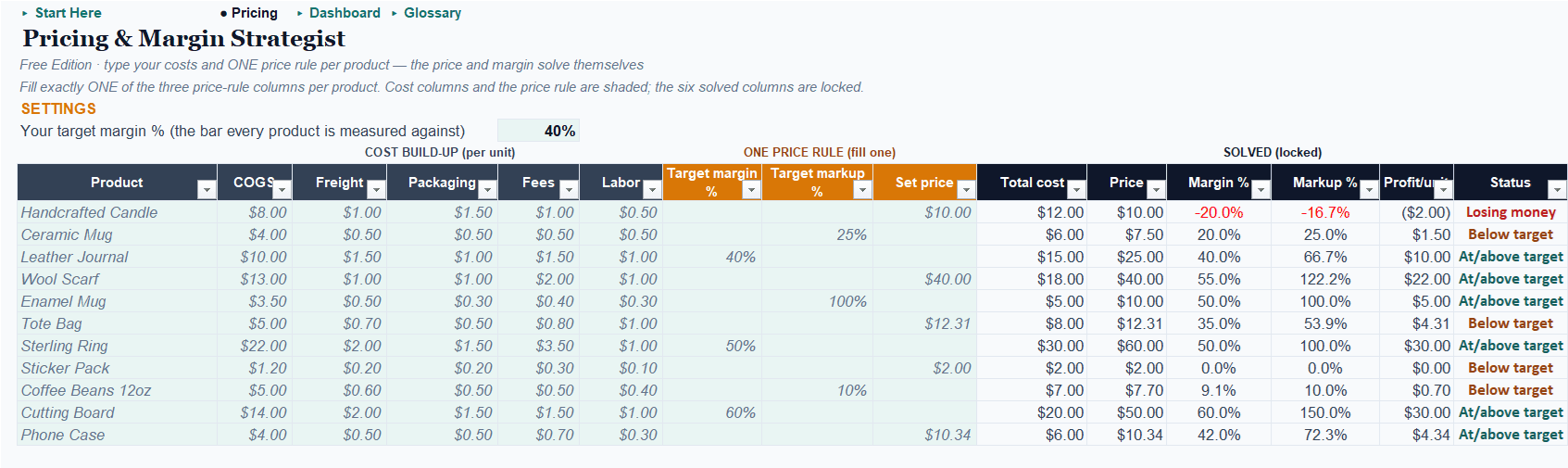
Item cost, freight, packaging, fees, labor — so the margin includes every cost.
Profit per saleMarkup vs. margin — settled side by side
A 25% markup is only a 20% margin — side by side, one row per product.
All-in marginThe exact price that hits your target margin
Type your target and it returns the exact price for every product, flagging each one currently below the bar with what fixing it is worth per unit.
Products below targetHow the pricing calculator works
1
Set your target margin at the top.
2
Per product: enter the cost pieces, then exactly oneprice rule — a target margin, a target markup, or your set price (it blocks a second rule so the math stays honest).
3
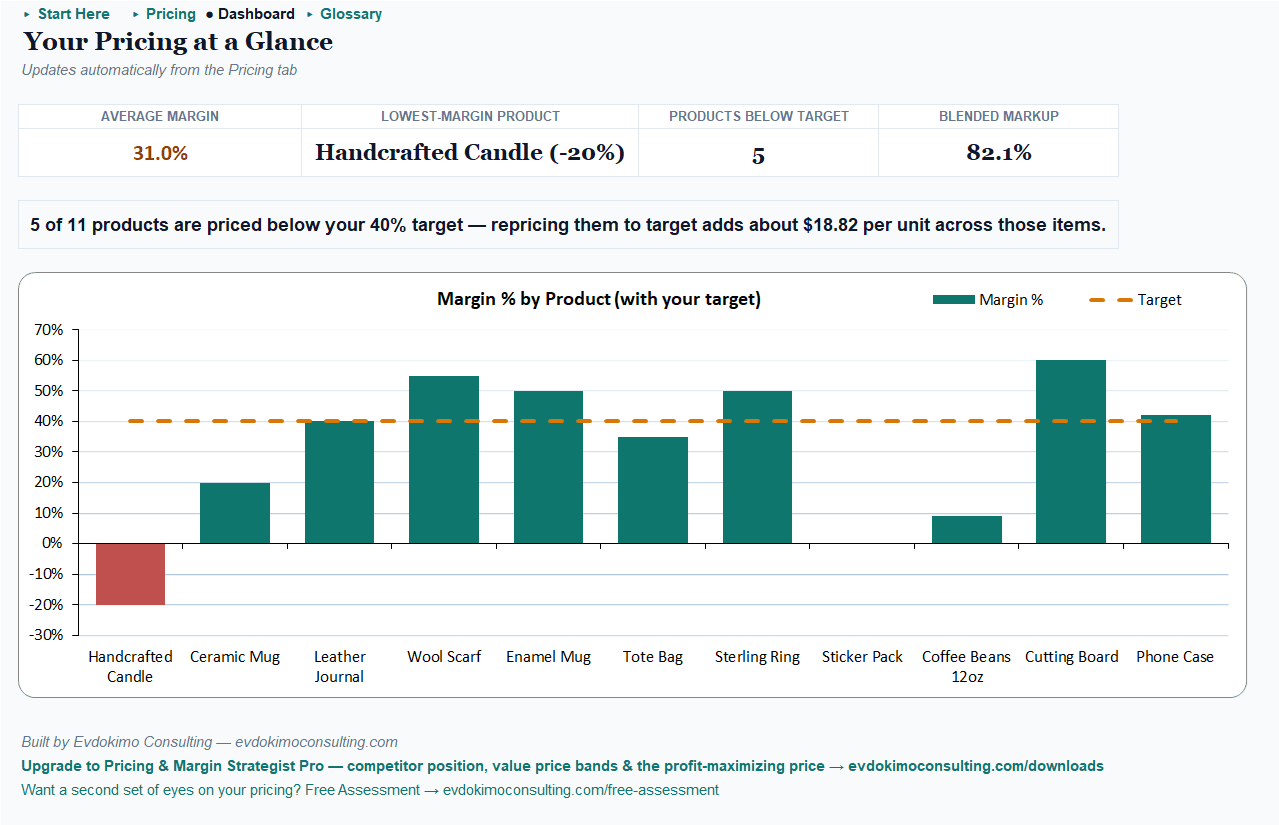
Read the Dashboard: average margin, lowest-margin product, count below target, and one plain-English line telling you what repricing is worth.
Works in Excel and Google Sheets (no macros)
The free edition is round-trip verified — start in Excel or upload to Google Drive and it works identically. No macros, nothing to enable.
See it in action: the maker’s catalog example
The workbook ships pre-filled with a fictional maker’s catalog where 5 of 11 products sit below the 40% target — including one selling at a −20% margin (losing money on every sale) — and the signal line prices the fix: about $18.82 more profit per unit across the underpriced items. Open it, see the flags, then type over the example with your own products.
Free vs. Pro: the price that maximizes profit
Start free. Free gets the math right — Pro finds the price that makes you the most money. Upgrading adds more decisions, never “unlocking the basics.”
| Free — Markup & Margin Calculator | Pro — Competitor + Scenario Pricing | |
|---|---|---|
| Price | Free (email) | $29 one-time |
| Platform | Excel and Google Sheets | Excel only (macros) |
| True cost build-up per product | ✓ | ✓ |
| Markup ↔ margin, side by side | ✓ | ✓ |
| Target-margin price solver | ✓ | ✓ |
| Below-target flags + per-unit fix value | ✓ | ✓ |
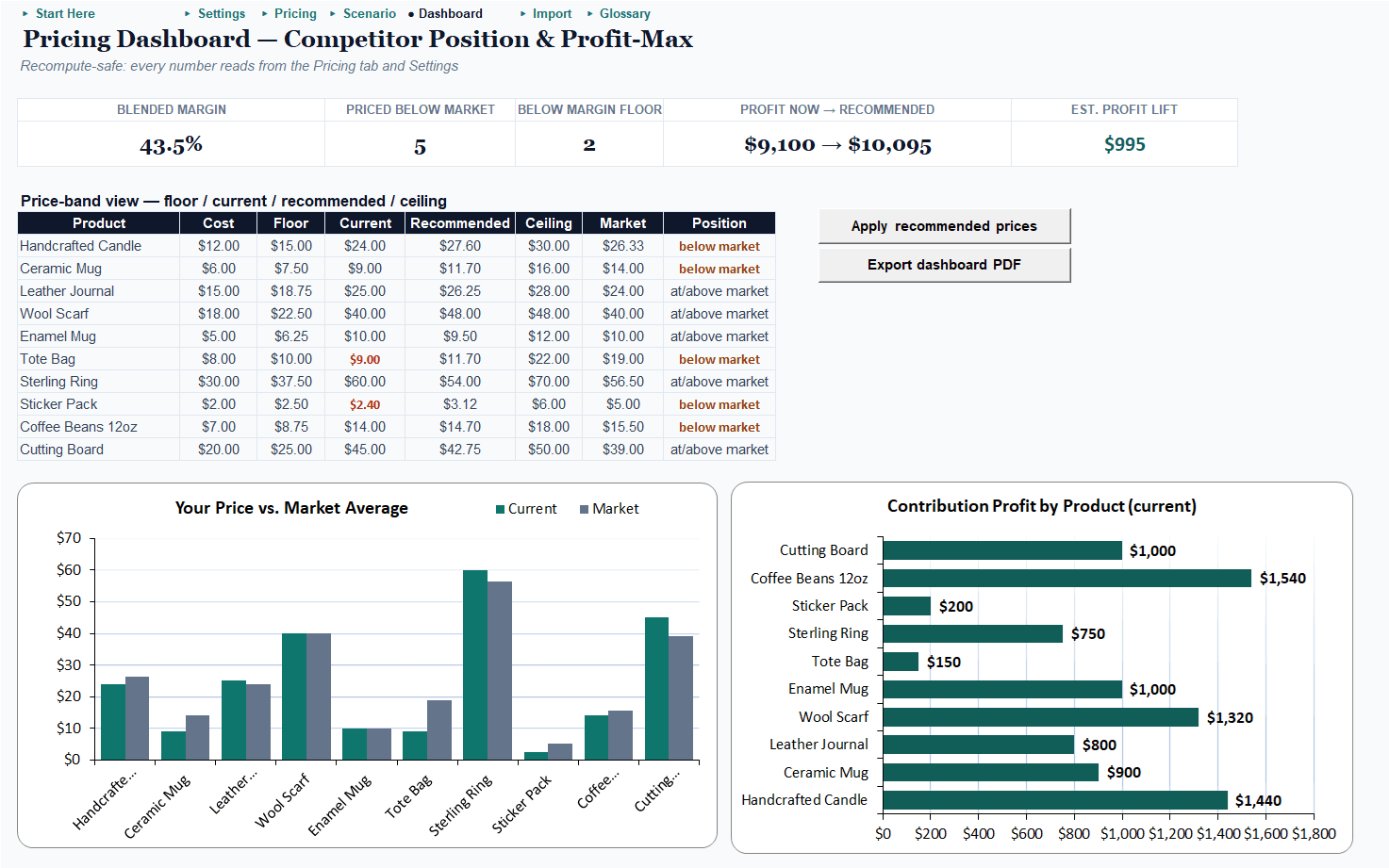
| Competitor position (up to 3 prices) | — | ✓ |
| Price floor & ceiling per product | — | ✓ |
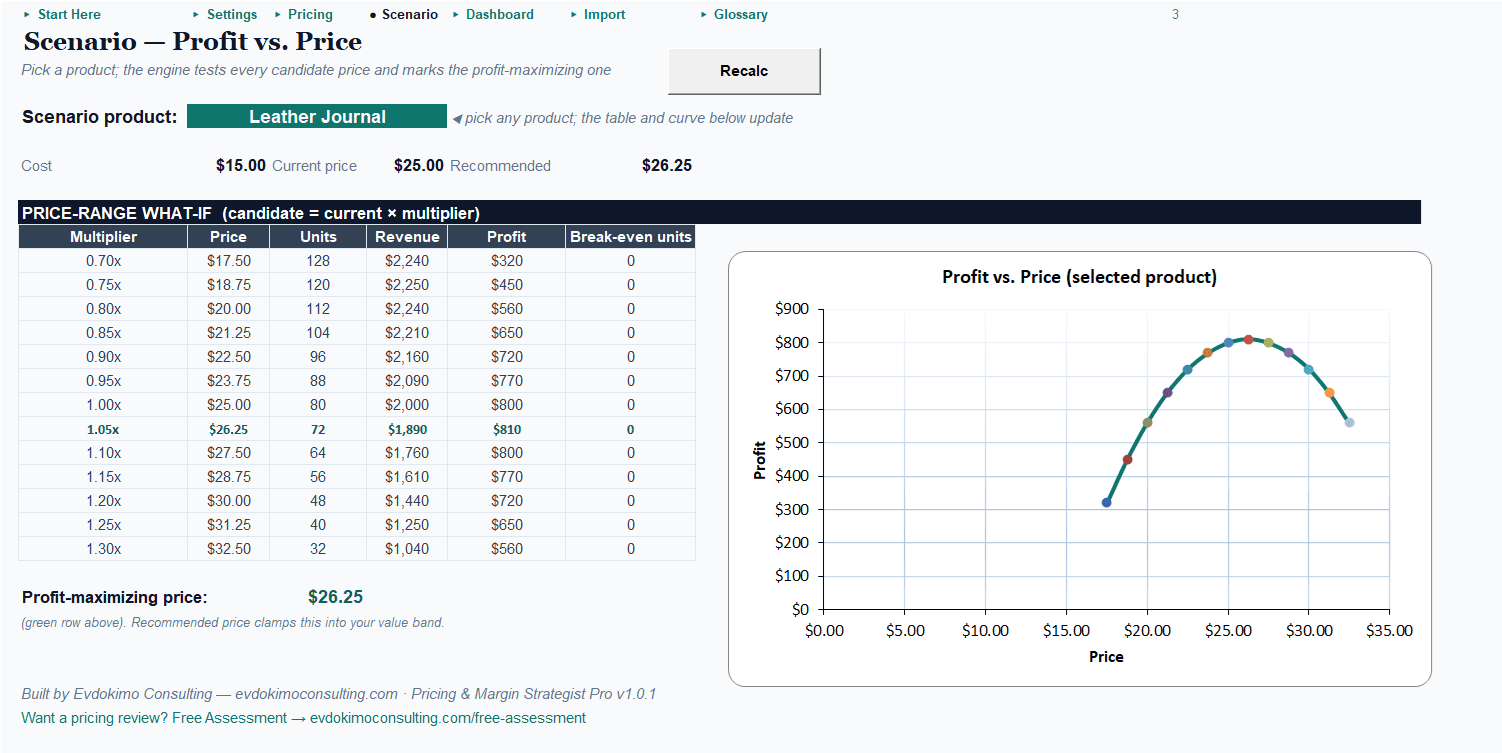
| Profit curve + profit-maximizing price | — | ✓ from your own demand answer |
| Price-cut detection (when down beats up) | — | ✓ |
| Apply recommended prices | — | ✓ one click, costs untouched |
| Portfolio view (which products carry the business) | — | ✓ |
| Shopify catalog import | — | ✓ |
| Paste-into-Claude AI commentary | — | ✓ (+ no-AI fallback) |
Free tells you what your margin is. Pro tells you what your price should be.
What’s the price that maximizes profit — not just covers cost?
Pro positions every product against up to three competitor prices, sets a floor (your minimum margin) and a ceiling (what the value supports), then tests a whole range of candidate prices against your own demand answer — “if I raise price 10%, I’d sell about X% fewer” — and marks the profit-maximizing price on a curve. It recommends inside your floor-and-ceiling band, can apply the new prices in one click without touching your costs, and shows the portfolio impact: the sample catalog’s recommendations add about $995 in profit (from $9,100 to $10,095). Sometimes the answer is a price cut — it finds those too. Shopify import included. Excel, one-time purchase.

Get the free pricing template
Enter your email and we’ll send the download link — plus a short series on getting the most from it.
We'll email the download link. No spam — unsubscribe anytime.
Every engagement comes with a number — the free tools included. Want a second set of eyes on your pricing? Start with a free assessment →
Frequently asked questions
Is it really free?
Yes — the Markup & Margin Calculator is a free download; we ask for your email so we can send the file and occasional useful tips. Unsubscribe anytime.
Do I need Excel, or does Google Sheets work?
Either. The free edition uses no macros and is round-trip verified in both Excel and Google Sheets — upload to Drive and it works identically.
What's the difference between markup and margin?
Markup is profit as a percentage of cost; margin is profit as a percentage of price. A 25% markup is only a 20% margin. The template shows both side by side for every product so the difference can't hide.
How does the target-margin solver work?
You set the margin you want; the template computes the exact price from each product's true built-up cost — item cost, freight, packaging, fees, and labor — and flags any product currently priced below the bar.
What does the Pro version add?
Competitor positioning, a floor-and-ceiling price band per product, and a profit curve that finds the profit-maximizing price from your own answer to “if I raise price 10%, how many fewer would I sell?” — plus one-click price application and Shopify import. One-time $29.
Is the recommended price guaranteed to be optimal?
No — it's an honest starting point built from your current sales and your demand estimate. Change a price, watch what actually sells, update the numbers, and the recommendation sharpens. That's how real pricing works.
Let’s find your number.
Start with the free pricing template — or tell me what you’re working on, and we’ll find the one metric worth moving first.